

Over the last quarter South Korea and Taiwan have seen astronomical returns and more recently have experienced extreme volatility.
The gains over the last 12 months can be traced directly to one industry—semiconductors. But now the global semiconductor index is down 25% from its peak.
Semiconductor chips have been on fire, but lately the heat has cooled.
For much of the past decade, investors have become accustomed to hearing that artificial intelligence (AI) is transforming the world. But while the spotlight has often been on software companies such as Microsoft, OpenAI and Alphabet, the real beneficiaries have been much deeper in the technology supply chain. The companies designing and manufacturing semiconductor chips have become some of the world's biggest winners.
Over the past 12 months, semiconductor-related stocks have produced extraordinary returns, helping drive remarkable gains in parts of Asia that many Australian investors have traditionally overlooked. The performance of both the Korean and Taiwanese share markets serve as a reminder that investment opportunities often emerge far beyond Australia and the United States.
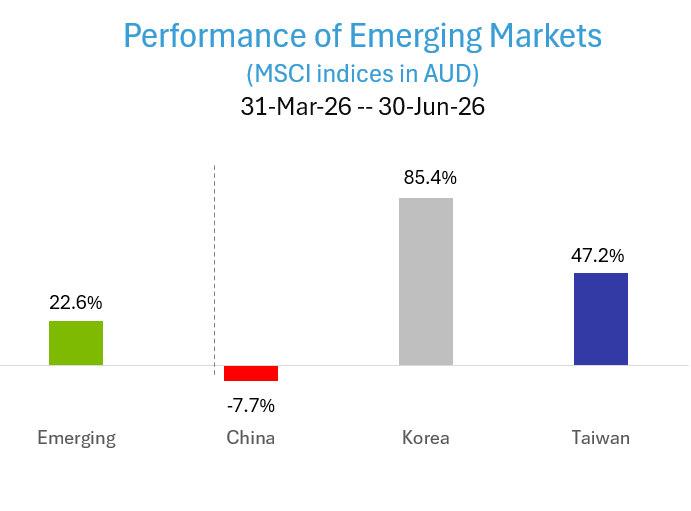
The gains have been unusually concentrated, with semiconductor giants such as Samsung Electronics and SK Hynix accounting for much of the market's advance as investors rushed to gain exposure to the AI boom. The Korean share market has gained an astonishing 85% during the June quarter alone, while Taiwan has also delivered exceptional returns, rising 46% over the same period. This has pushed the MSCI Emerging Index to record a return of 22.6% over the June quarter, as shown in the chart below [1].
Taiwan is home to the world's largest and most advanced semiconductor manufacturer, Taiwan Semiconductor Manufacturing Company (TSMC). The company produces cutting-edge chips for many of the world's leading technology firms, including Apple, Nvidia, AMD, Qualcomm and Broadcom. As AI demand has exploded, TSMC has found itself at the centre of one of the largest technology investment cycles in history.
Korea has benefited through companies such as Samsung Electronics and SK Hynix. While Samsung is well known for smartphones and consumer electronics, it is also one of the world's largest producers of memory chips. SK Hynix has become a critical supplier of High Bandwidth Memory (HBM), an essential component used in Nvidia's latest AI processors.
The extraordinary performance of Korea and Taiwan over the last 12 months has presented headwinds for those active managers who are benchmarked against the MSCI Emerging Market index but have different weights to the market leaders*. The 1 year return of Australian active emerging market funds varies from -10% to + 60% against the index return of 36%. For the Australian EM sector, 88% of funds underperformed the MSCI index[2].
Demand for these advanced memory chips has surged as AI models become increasingly larger and more computationally intensive. The largest technology companies—including Microsoft, Amazon, Alphabet, Meta and Oracle—are collectively spending hundreds of billions of dollars building AI data centres around the world. This capital expenditure (capex) includes servers, networking equipment, power systems, cooling infrastructure and, most importantly, millions of advanced semiconductor chips.
The long-term outlook for semiconductor demand remains compelling. AI adoption is still in its early stages, cloud computing continues to expand, autonomous vehicles require increasingly sophisticated chips, and the "Internet of Things" will continue connecting billions of additional devices over coming decades.
However, history suggests that industries experiencing rapid growth rarely move in a straight line. Recent market volatility highlights that even the strongest-performing markets remain vulnerable to setbacks. Over the past few weeks, both Korean and Taiwanese share markets have experienced increased volatility as investors reassessed earnings expectations and broader global economic risks.
As the chart below shows, the Global Semiconductor index [3] has fallen dramatically since its peak near the end of June and is now down by more than 25% since that time. It’s not only semiconductors that are down, the broader tech sector in the US is also off its late June highs.
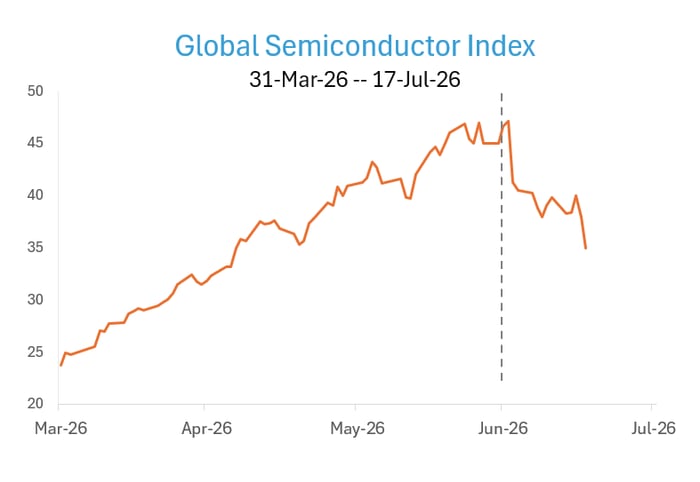
AI and semiconductor stocks have tumbled as Investors have begun questioning whether AI spending can continue at its current pace. The emergence of increasingly capable and lower-cost Chinese AI models—including Moonshot AI's Kimi K3—has raised concerns that US technology companies may not need to spend quite as aggressively on computing infrastructure. If AI investment moderates, demand for advanced chips could also soften, prompting the recent sell-off across semiconductor stocks.
The semiconductor industry has always been cyclical. Periods of exceptionally strong demand are often followed by temporary oversupply, inventory corrections or slower capital spending. Even companies with excellent long-term prospects can experience significant share price volatility if investor expectations become too optimistic. So while semiconductor chips have been on fire over the past year, the recent pullback serves as a timely reminder that even the strongest investment themes experience periods of cooling.
Many Australian investors naturally have significant exposure to local banks and mining companies, while global investing is often dominated by large US technology firms. However, some of the most attractive investment opportunities emerge elsewhere. Countries such as Korea, Taiwan and even China can provide exposure to industries and companies that are difficult to access through Australian markets alone.
The remarkable performance and volatility of Korea and Taiwan over the last few months illustrates why maintaining broad global diversification remains so important.
Rather than attempting to predict which country or sector will outperform next, a globally diversified portfolio allows investors to participate wherever innovation and economic growth occur.
After all, the future of technology is unlikely to be built in just one country—and neither should a well-diversified investment portfolio.
This article was written by Dr Steve Garth - Principal of Principia Investment Consultants.
Disclaimer: Although information is derived from sources considered and believed to be reliable and accurate, Principia and its employees are not liable for any opinion expressed or for any error or omission that may have occurred in this presentation. This presentation is of a general nature only and has been prepared without considering any person’s particular investment objectives, financial situation, or particular needs.
If you need to speak with a financial adviser, please use the button below to enquire
[1] Currently the market cap weighting of the countries in the MSCI Emerging Market index are 27% for Taiwan and 24% to South Korea, while China stands at 19% and India at 11% (these weights are constantly changing as market returns vary across countries).
[2] Data from FE Analytics for the Australian Managed Investments Emerging Market sector, for funds > 3 years since inception and > $100MM in AUM and quoted benchmark is the MSCI Emerging Market Index.
[3] The chart is the Global X Semiconductor ETF (ASX: SEMI) which tracks the Solactive Global Semiconductor 30 Index. Source data www.investing.com in AUD)
Leave a Comment