

Government bond yields have been steadily rising across much of the world, with some long-term yields reaching their highest levels in more than a decade.
The move reflects a combination of concerns about inflation, government borrowing, changing monetary policy and the enormous amount of capital required to fund the global artificial intelligence boom.
What does this mean for the stock market?
The yield on the 30-year US Treasury bond recently rose above 5%, its highest level since 2007. Similar long-term government bonds in Australia, Canada, Japan, Germany and elsewhere have also reached their highest yields in at least a decade.
For equity investors, the key question is whether rising bond yields are simply a normal adjustment to a changing economic environment—or an early warning of something more significant.
Bond prices and yields move in opposite directions. When investors sell bonds, prices fall and yields rise. Government bond yields are important beyond the fixed interest market because they provide a benchmark for borrowing costs throughout the economy, influencing corporate debt, consumer loans and mortgages.
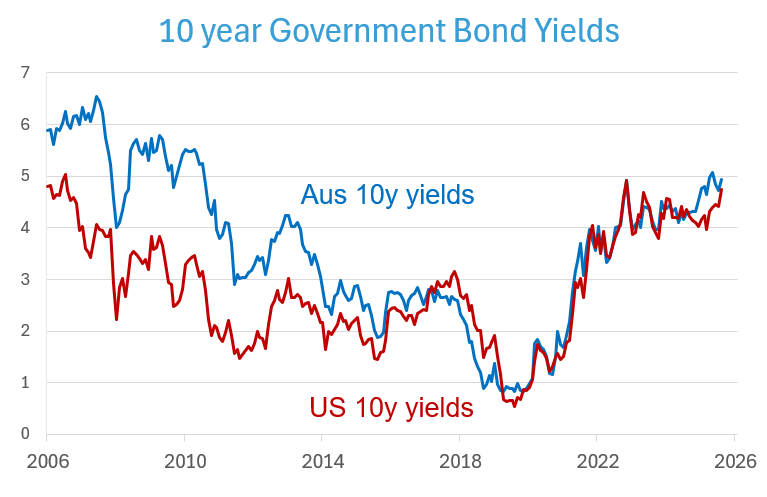
The chart below shows the 10-year government bond yields of the US and Australia. Over the last 10 years the yields of the two countries have moved in tandem, but prior to 2015 Australian yields (and overnight cash rates) were significantly higher than in the US. Now Australian yields have hit 5% for the first time since 2011, while the US bond market has not seen yields at this level since 2007.
There is no single explanation for why yields are moving higher around the world. Inflation remains part of the story, but long-term inflation expectations have not increased significantly. Perhaps the most important factor is the relentless increase in government debt and deficits.
Governments around the world are borrowing heavily, while there appears to be limited political appetite to address the problem through spending reductions or higher taxes. The US provides perhaps the clearest example. Its national debt is projected to reach US$50 trillion by 2029, while interest payments alone amounted to around US$1.4 trillion over the past year.
The concern for bond investors is straightforward: the more governments need to borrow, the greater the supply of bonds that must be absorbed by investors. If demand does not keep pace with supply, governments may have to offer higher yields to attract buyers.
This creates a potentially uncomfortable feedback loop. Higher debt leads to greater interest payments, which can increase government deficits and require even more borrowing. Over time, investors may demand a higher return to compensate for the growing risks associated with government finances.
Governments are also competing for investors’ money with the corporate sector. The global AI investment boom is requiring enormous amounts of capital, with major technology companies increasingly tapping corporate bond markets to help finance data centers and other infrastructure.
Another factor is the changing approach of the US Federal Reserve under its new chair, Kevin Warsh. For many years, the Fed provided markets with considerable guidance about how it might respond to changing economic conditions. This forward guidance helped investors anticipate potential interest-rate moves and reduced uncertainty.
Since taking over in late May, he has reduced the amount of guidance provided to markets. Less certainty about future monetary policy can translate into greater uncertainty for bond investors—and potentially higher yields as investors demand additional compensation for that uncertainty.
Perhaps the most interesting aspect of rising bond yields is that equity markets have largely shrugged it off. The increase in yields has been gradual rather than sudden, giving investors little reason to panic. Major share market indices remain close to record highs, supported by strong earnings growth in the US and continuing enthusiasm surrounding AI.
This highlights an important difference between bond and equity investors. Share investors are focused on strong corporate earnings and the potential for AI to generate substantial future profits. Bond investors, meanwhile, appear increasingly concerned about government finances, the supply of debt and the return required to lend money for the long term. At some point, these perspectives may come into conflict.
Higher bond yields can affect share markets in several ways. First, they increase borrowing costs for companies, potentially making investment more expensive and reducing future profits. Second, higher government bond yields provide investors with a more attractive alternative to shares. When a relatively safe government bond offers a substantially higher return, investors may become less willing to pay high valuations for riskier assets.
The relationship is not mechanical, however. Share prices can continue rising even as bond yields increase, particularly when corporate earnings are growing strongly. That appears to be what has happened so far. The question is how far yields can rise before they begin to have a more meaningful impact on economic growth, corporate profits and equity valuations.
It is too early to say that rising bond yields signal an imminent correction in global share markets. There are many reasons why yields can rise without causing a significant disruption to equities. The combination of high government debt, persistent fiscal deficits, increased corporate borrowing to fund the AI boom and uncertainty about future monetary policy has created an environment in which the cost of capital is moving higher. For now, the rise in yields has been orderly and equity markets remain remarkably resilient.
But bond markets tend to be less driven by optimism than share markets. They are increasingly signaling that investors want to be paid more to lend money for the long term. We don’t know when—or even whether—that warning will translate into weaker share markets.
This article was written by Dr Steve Garth - Principal of Principia Investment Consultants.
Disclaimer: Although information is derived from sources considered and believed to be reliable and accurate, Principia and its employees are not liable for any opinion expressed or for any error or omission that may have occurred in this presentation. This presentation is of a general nature only and has been prepared without considering any person’s particular investment objectives, financial situation, or particular needs.
If you need to speak with a financial adviser, please use the button below to enquire
Leave a Comment