

This is a common question, and the answer isn’t straightforward.
The most accurate response is one we often borrow from economists: “it depends”.

Table of Contents
How does borrowing to invest work?
What are the potential benefits of borrowing to invest?
What are some of the main risks?
How can I tell if borrowing to invest is right for me?
How does borrowing to invest work?
Before considering whether borrowing to invest is appropriate for you as a financial strategy, it’s important to understand how it actually works. You may also hear this referred to as “gearing”.
The concept is simple:
You want to acquire an asset you can’t afford right now.
Rather than waiting and saving until you have enough to purchase it outright, you borrow the money.
In most cases, this is from a bank (non‑bank lending is possible, but typically higher risk).
Banks will only lend on terms that protect their position. They charge you interest on the loan and they take security over one or more of your assets (often the asset you are purchasing).
If you fail to meet your obligations, they can sell that asset to recover what is owed.
At first glance this can appear to favour the bank, so what is in it for you?
In essence, you expect to receive value – financial and/or personal – from owning that asset sooner rather than later.
Ask an adviser about borrowing to invest
What are the potential benefits of borrowing to invest?
The primary benefit of borrowing to invest is immediate access to an asset you expect will provide value over time, without needing the full purchase price upfront.
That value usually comes from investment returns – income, capital growth, or both.
Because your initial capital outlay can be relatively small, the returns (positive or negative) on your contribution can be significant.
For this to make sense, the future value of the investment needs to compensate you for:
-
repaying the loan principal; and
-
covering the interest costs over the life of the loan.
There can also be tax benefits.
In many cases, interest on investment loans is tax‑deductible, which may improve the after‑tax affordability of the strategy (for example, by reducing your net cost and giving you more time to realise the value of the investment).
Borrowing to invest can also provide flexibility and speed. It can allow you to act quickly on opportunities and avoid holding large amounts of idle cash while you wait to invest.
What are some of the main risks?
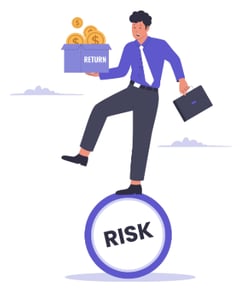
While borrowing to invest can be effective in the right circumstances, it also introduces additional risks.
Some of the key risks include:
Market risk and volatility
The value of your investment can move up and down, sometimes sharply, particularly over shorter timeframes. You may experience extended periods of negative returns and a net loss position. Just as gearing can magnify gains, it can also magnify losses.
Interest rate risk
Interest rates may rise, increasing the cost of maintaining your loan. Higher repayments may place pressure on your cashflow and may require you to divert income from other purposes to avoid defaulting.
Employment and business risk
If your income reduces or stops (for example, through job loss, reduced hours, business downturn or illness), your loan repayments continue. Reduced income can force you to sell investments at an unfavourable time in order to service or clear the debt.
Security and asset loss
If you are unable to meet loan conditions, the lender may enforce their security, which can include selling the asset or assets used as collateral.
Importantly, many of these risks are outside your direct control.
However, when borrowing to invest is considered as part of a comprehensive financial plan, some of these risks can be managed or reduced.
Your investment timeframe, access to liquid reserves, diversification, debt structure and insurance arrangements, for example, all play a role in managing downside risk.
Learn more about investment risk
How can I tell if borrowing to invest is right for me?
Determining whether borrowing to invest is suitable for you requires a holistic view of your situation rather than a simple rule of thumb.
A qualified financial adviser can help you:
-
clarify your goals and timeframes
-
understand your risk capacity and risk tolerance
-
assess your current financial position, including cashflow and existing debts
-
consider how you might respond emotionally to market volatility and the obligations of a geared strategy
-
structure any borrowing in a way that aligns with your broader financial plan.
Ask an adviser about borrowing to invest
Borrowing to invest is not appropriate for everyone.
Where it is suitable, it should be designed and implemented in conjunction with an experienced, independent financial adviser who can help you understand the trade‑offs, model different scenarios and review the strategy over time.
The information provided is factual only and does not constitute financial advice. If you need to speak with a Financial Adviser before making a decision, you can contact us via the button below.


Leave a Comment