

When you start thinking about investing, a term that you will quickly come across is ‘Risk’.
The idea of risk can make 'would-be' investors nervous, especially when it can be hard to figure out what exactly is meant by Risk… Risk of what?
This post will answer that question. We will also guide you through why risk can help you reach your goals and some strategies to manage your risk when investing.
You don’t need to be a finance whiz! You just need a few expert tips, and a healthy dash of common sense to start investing with more confidence.
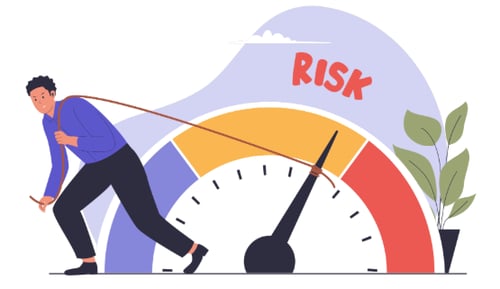
What is Investment Risk?
When talking about investment risk we need to consider what we are doing and why.
When we invest, we use money to acquire assets that have the potential to grow in value or generate income over time.
We invest to achieve some financial goal in the future. That goal could be building wealth for retirement, saving for a home, or helping your children through their education.
Whatever the goal is, risk is the chance that you do not achieve those goals.
Speak with a Financial Adviser about managing your Investment Risk.
Why take on Risk?
You may now be considering, why should you take on risk if it means that you may not achieve your goals?
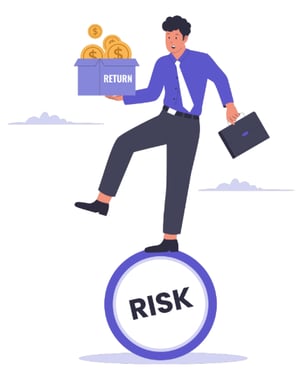
The answer has to do with the relationship between risk and return.
The more risk you take on, the higher you should expect your returns over the long term to compensate for that risk.
This at first may seem odd.
Shouldn’t higher returns make it easier to reach my goals?
Well, as risk increases, so does the chance that your risky investment has a low or negative return in a given period. This can cause an investment portfolio to fluctuate in value over the short term which is referred to as ‘volatility’.
If you try to take on no volatility however, your returns can be so low that you are exposed to an entirely different risk. That risk is that inflation will outpace the growth of your investments.
Here’s the good news: You can manage risk in a way that suits your goals and your comfort level.
Types of Risk
If you're looking for the best place to invest money without risk, it doesn't exist.
Any investment comes with a level of risk. That’s why it helps to understand the different kinds of risks out there.
Not all investments carry the same risks, and some might suit you better than others.
We can think of investments in two main groups:
- Defensive assets (low risk investments)
These are like the steady, reliable mates of your investment world. Things like savings accounts, term deposits, and government bonds generally don’t move around much in value. The main risk here is that your money might not grow fast enough to keep up with the cost of living (inflation). - Growth assets (high risk investments)
Shares, property, and similar investments can go up and down in value, sometimes quite a bit in the short term. But over the long run, they give you a better shot at growing your wealth. Of course, there’s always a chance they could drop in value too, especially over shorter periods.
The key is finding the right balance for you - how much are you willing to see your investments move up and down, and how important is it for your money to grow faster than inflation?
The Power of Diversification
Ever heard someone say, “Don’t put all your eggs in one basket?” That’s risk management in a nutshell.

Managing risk is all about matching your investments to your goals and your comfort with ups and downs. There’s no crystal ball to predict which type of investment will do best each year, so it’s about what helps you sleep at night and keeps you on track for your goals.
Matching your investments to your goals starts with deciding on how your portfolio should be allocated between Growth and Defensive assets.
The next step to manage risk after deciding on your asset allocation is using a strategy called ‘diversification’.
It is impossible to accurately and consistently predict what investments will do well and what will do poorly, so the best practice is to cast a wide a net so that no particular asset determines your portfolio’s performance.
Other Risks and Tips to Manage Them
There are some more specific risks than can impact your ability to achieve your objectives.
1. Concentration Risk
A fall in value in a single investment, market sector, or asset class has an outsized impact on your portfolio.
How to manage: Use diversification (avoid the “all eggs, one basket” trap).
2. Liquidity Risk
You are unable to convert your investments into cash when you need to.
How to manage: Maintain a contingency fund of safe and liquid assets to fund expenditures in times of stress.
3. Cost Risk
High fees and taxes detract from your investment returns.
How to manage: Invest through low cost and tax effective investment options.
4. Emotional Investing Risk
You let your emotions dictate your investment decisions.
How to manage: Have a disciplined approach to your long-term investment plan. A Financial Adviser will help keep you on track and guide you through the emotions of investing without acting on them.
5. Short Term Focus Risk
You focus on short term benefits (such as trying to time the markets or jumping on the latest investment trends) at the cost of the long term.
How to manage: Have a long-term plan in place and understand that there is no magical quick solution.
Common mistakes people make when investing (and how to avoid them)
Wrapping Up
Risk is an unavoidable part of investing. But if you understand what it really means, and use straightforward tools like diversification, you can manage your risk and grow your money with much more confidence.
There’s no such thing as a risk-free investment, but there are plenty of smart ways to reduce the anxiety and set yourself up for lasting success.
Just remember: The best portfolio isn’t the one with the highest returns - it’s the one you’ll stick with through ups and downs.
The information provided is factual only, and does not constitute financial advice. If you need to speak with a Financial Adviser before making a decision, you can contact us via the button below.


Leave a Comment