

Much has been written about the wave of blockbuster initial public offerings (IPOs) arriving on public markets. SpaceX listed on 13 June, while OpenAI and Anthropic are expected to follow later this year.
As some of the world’s largest technology companies enter public markets, many investors are asking how these additions will affect index funds and diversified portfolios.
The answer may be less dramatic than many expect.
While these companies command enormous valuations and attract significant media attention, their impact on broadly diversified portfolios is likely to be modest, at least initially.

The Rise of the Mega-Cap IPO
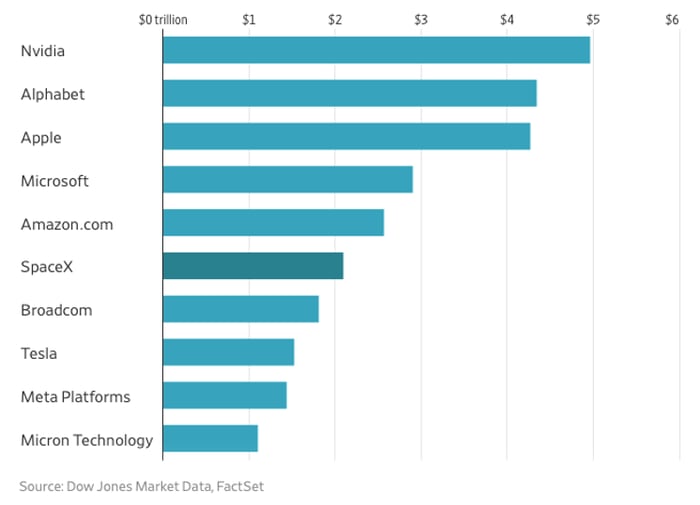
SpaceX made history with a US$75 billion IPO, instantly becoming one of the world’s largest publicly listed companies. Following a strong market debut, the company’s valuation climbed above US$2 trillion, making it the sixth-largest listed company in the United States.
The success of the SpaceX listing has heightened expectations for future IPOs from OpenAI and Anthropic, the companies behind ChatGPT and Claude respectively. Their eventual arrival on public markets will further increase the representation of large technology businesses within major equity indices.
This has fueled concerns that the US share market, already highly concentrated, could become even more dependent on a handful of mega-cap technology stocks. Prior to the SpaceX listing, the so-called “Magnificent Seven” technology companies already accounted for approximately 35% of the total value of the S&P 500 Index.
However, market capitalization alone does not determine a company’s influence within major indices.
SpaceX Is Large, But Its Free Float Is Small
SpaceX is valued at more than US$2 trillion, which makes it instantly the sixth largest company in the US, as the chart below shows. However, index providers do not assign weights based on total market capitalization. Instead, most major indices use a free-float-adjusted methodology, meaning only shares available for public trading are included in the calculation.
For SpaceX, this distinction is significant. Approximately 5% of the company’s shares are currently available for public trading, while more than 95% remain subject to lock-up restrictions.
Because of SpaceX’s extensive private funding history, insider and early-investor holdings are being released under a staggered schedule rather than a single lock-up expiry date. Elon Musk alone controls approximately 42% of the company’s equity and is expected to remain restricted from selling for at least the first year following the IPO.
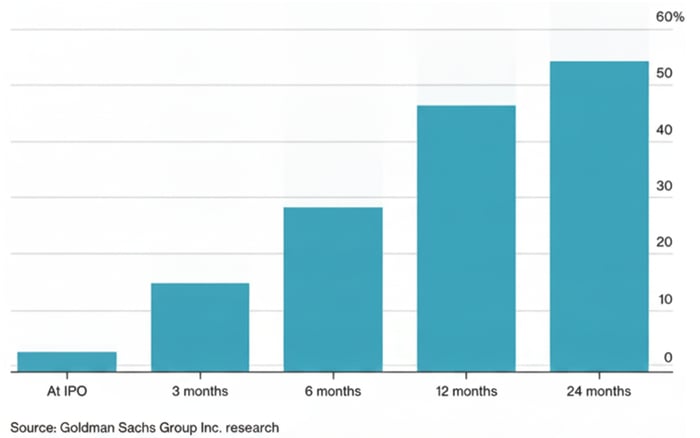
History suggests that free float tends to expand steadily after listing. As the chart below shows, for large IPOs that begin with less than 10% free float, median free float typically rises to around 25% after six months and exceeds 50% within two years.
As a result, while SpaceX’s total valuation is enormous, its initial representation in market indices is far smaller than many investors assume.
Index Providers Are Adapting to Mega-Cap Listings
Historically, newly listed companies often faced waiting periods before becoming eligible for inclusion in major indices, particularly if they were not yet profitable. However, index providers have increasingly modified their rules to accommodate exceptionally large IPOs.
Current policies include:
- MSCI Global Standard Indexes: SpaceX was added to MSCI benchmarks through the provider’s fast-track process for large IPOs, allowing inclusion shortly after listing.
- S&P 500 Index: Eligibility rules remain unchanged. Companies must generally wait 12 months after listing, satisfy minimum liquidity and float requirements, and demonstrate positive aggregate earnings over the previous four quarters.
- Nasdaq-100: Recent rule changes allow qualifying mega-cap IPOs to enter after as little as 15 trading days.
- FTSE Russell: Large companies may become eligible for inclusion in Russell indices after only five trading days.
For many Australian investors, the most relevant benchmark is the MSCI World ex Australia Index, which underpins products such as the Vanguard MSCI International Shares ETF and serves as a performance benchmark for many active managers.
The inclusion of SpaceX requires passive index-tracking funds to purchase the stock. However, due to its limited free float, analysts estimate that its initial weighting will be only around 0.03% to 0.05% of the index. This would place the company well outside the largest holdings despite its headline valuation.
Consequently, the immediate impact on investors holding broad international index funds is likely to be negligible. Any meaningful increase in SpaceX’s weighting will depend on a substantial expansion of its publicly traded share base over time.
The Bigger Impact May Be on Sector Weights
While the effect on overall index composition is small, the arrival of SpaceX, OpenAI and Anthropic could gradually influence sector allocations.
Australian investors are familiar with market concentration. The Financials and Materials sectors together account for more than half of the ASX 200, reflecting the dominance of banks and mining companies.
The US market exhibits a different form of concentration. Information Technology and Communication Services—home to companies such as Nvidia, Microsoft, Apple, Alphabet and Meta—already account for more than 40% of the S&P 500.
If SpaceX, OpenAI and Anthropic are ultimately classified within the Communication Services sector, the sector’s weighting could rise from approximately 11% today to somewhere between 13% and 14% as their free floats increase over time.
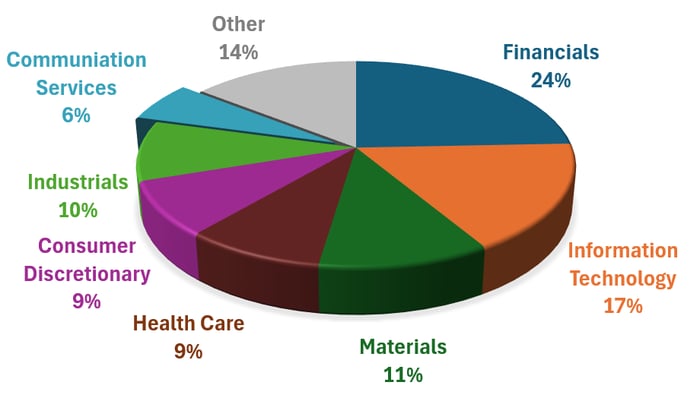
However, investors with globally diversified portfolios should recognize that sector exposures tend to balance out across regions. For example, a portfolio invested 50% in the ASX 200 and 50% in the MSCI World ex Australia Index produces a much more diversified sector allocation than either market alone.
In such a portfolio, Financials and Materials would represent roughly 35% of total exposure, while Information Technology and Communication Services would account for around 24%. Other large sectors would generally sit closer to 10% each.
As a result, even if Communication Services gains several percentage points within the US market, the effect on a diversified global portfolio would be substantially diluted.
Conclusion
The listing of SpaceX—and the anticipated IPOs of OpenAI and Anthropic—represent significant milestones for public markets. They will undoubtedly attract investor attention and further reinforce the dominance of large technology companies within US equity indices.
However, for investors holding broad, diversified index funds, the practical impact is likely to be far smaller than the headlines suggest.
Free-float-adjusted index methodologies, combined with the relatively small initial public shareholdings of these companies, mean their early index weightings will remain modest.
Over time, as more shares become available for trading, their influence may increase. For now, however, investors in diversified portfolios are unlikely to see any meaningful change in performance or risk simply because these high-profile companies have joined the market.
This article was written by Dr Steve Garth - Principal of Principia Investment Consultants.
The information provided is factual only and does not constitute financial advice. If you need to speak with a Financial Adviser before making a decision, you can contact us via the button below.
Leave a Comment