

The first quarter of 2026 has been dominated by an escalation of conflict in the Middle East.
In late February, the United States and Israel launched coordinated strikes on Iran, which responded by targeting energy infrastructure across the Gulf region.
The resulting surge in energy prices has heightened concerns about rising inflation and a slowdown in global growth.
Video:
Fears have intensified as signs emerge that the conflict could broaden. In particular, disruptions in the Strait of Hormuz—a critical shipping route for roughly one-fifth of global crude supply—have raised the risk of sustained supply shocks, with missile and drone threats significantly curtailing tanker traffic. The prospect of a prolonged conflict, coupled with “higher for longer” inflation, is now threatening to undermine the multi-year bull run in global equity markets.
Markets had already experienced heightened volatility in late January. At that time, investors were grappling with two key AI-related concerns: whether the substantial investment in AI would ultimately deliver expected returns, and the extent to which AI-driven disruption could impact parts of the software sector—along with the flow-on effects for a number of private credit funds.
The sharp rise in energy prices has since accelerated the sell-off in equity markets, as investors increasingly fear that renewed inflationary pressures could derail the recovery in global growth. At their March meetings, the US Federal Reserve held interest rates steady despite signs of economic slowing, while the Reserve Bank of Australia raised rates for a second consecutive time, with inflation already above its 2–3% target band prior to the energy price spike.
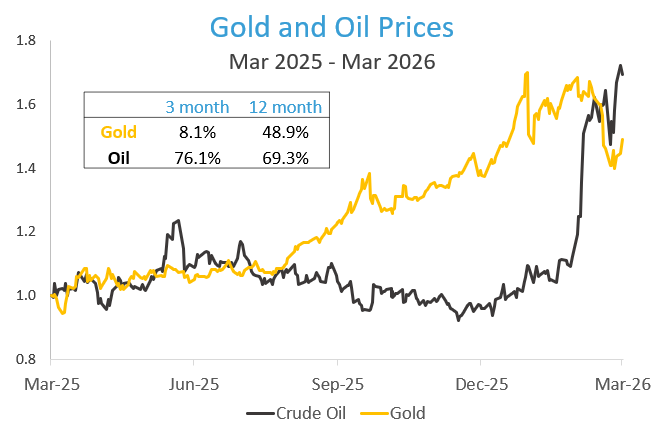
The rise in energy prices – crude oil is up 80% for the quarter - has also created a volatile bond market as traders balance the trade-off between higher inflation expectations and slower global growth. The bond market has been weighing more to the inflationary impact of higher energy prices rather than the need for a safe-haven asset, although recently yields have started to fall.
Gold, typically viewed as a defensive asset, has fallen by 12% from its high, pressured by a stronger US dollar and rising bond yields. Across all asset classes, performance has been broadly negative for the quarter, including equities, bonds, private assets and cryptocurrencies.
The current volatility should be seen in context of a longer time frame. Equity Markets have been in a significant bull market since the end of 2022, with the MSCI World Index returning over 60% (in AUD) over the last 3 years. Long-term investors are encouraged to remain disciplined and diversified, and to ignore the uptick in volatility caused by current events.
Equity and Bond Market Overview
VOLATILITY RETURNS
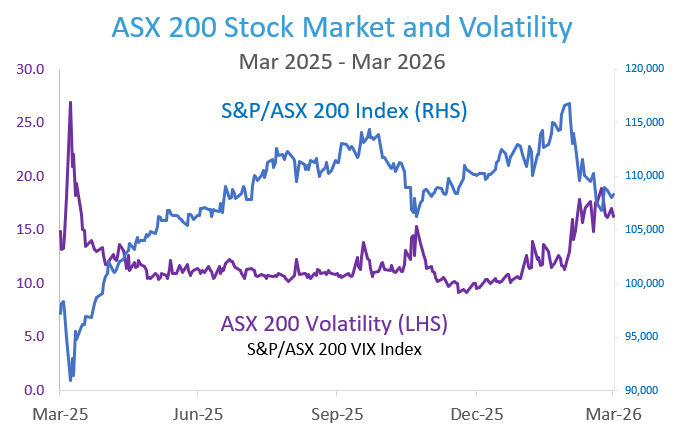
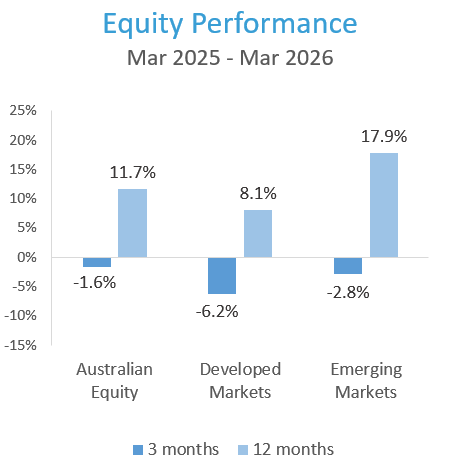
The ASX hit an all-time high in late February before the conflict in the Middle East began. The volatility index has reached its highest levels in 12 months, as surging oil prices signal higher inflation and a moderation in economic growth. However, the ASX is only down -1.6% for the quarter and has returned 11.7% for the previous 12 months.
THE CONFLICT IN THE MIDDLE EAST AFFECTS ALL MARKETS
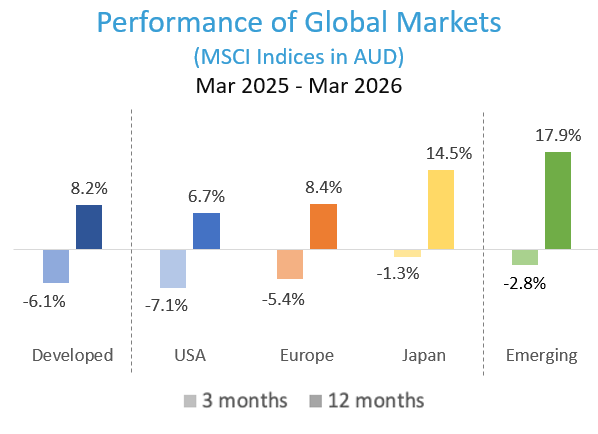
The rally of global share markets after the initial introduction of tariffs were paused in April 2025 continued up until the end of February when the conflict in the Middle East escalated. The result is a significant tightening in global energy markets and markets are now pricing a more prolonged disruption – affecting inflation and global growth expectations.
BOND YIELDS BALANCING A COMPLEX TRADE-OFF
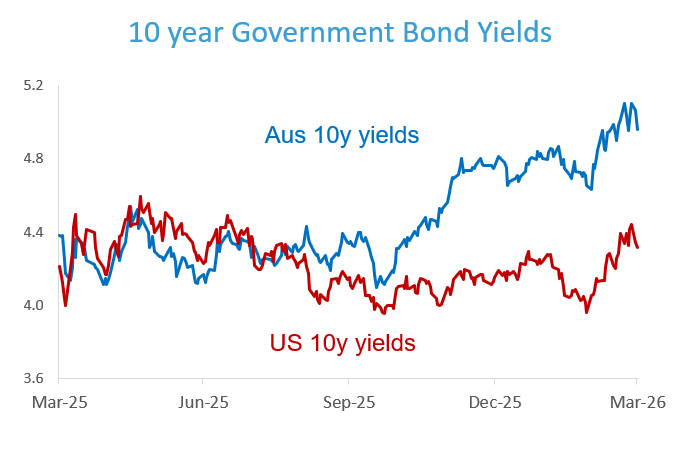
Higher energy prices are feeding through to inflation expectations while simultaneously weighing on growth, creating a more volatile backdrop for bond yields. So far investors have been more concerned about the inflationary impact of higher oil prices than they are about the need for a safe-haven asset, reversing the typical "flight-to-safety" trend.
Economic Review and Forecasts
STUBBORNLY HIGH INFLATION COMPOUNDED BY OIL PRICES
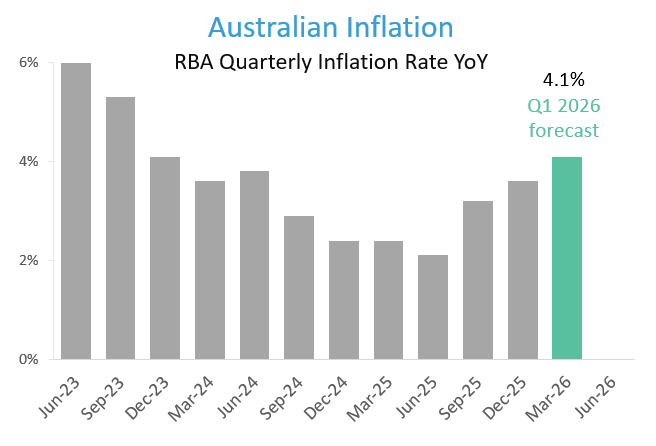
The RBA halted its easing cycle following higher-than-anticipated Q3 2026 inflation, reinforced by Q4 data showing headline CPI remaining stubbornly high at 3.6%. Now compounded by rising energy prices the inflation rate is forecast to hit 4% this quarter; however, significant uncertainty remains regarding the impact of the ongoing conflict.
AUSTRALIAN GDP GROWTH FUELLING INFLATION
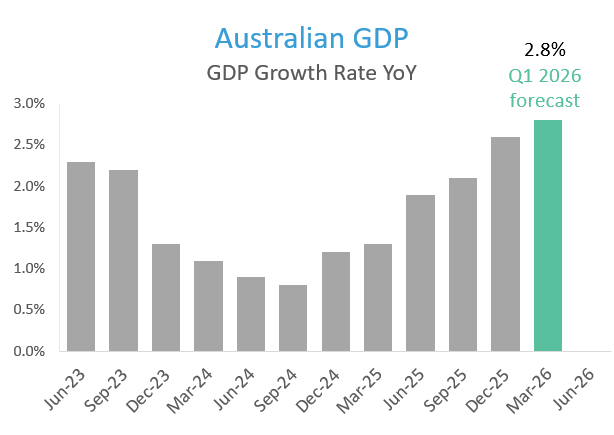
The Australian economy expanded 2.6% year-on-year in Q4 2025, more than the expected 2.2% growth. Economists are concerned the rate is overheating the economy and pushing inflation higher, while the conflict in the Middle East has complicated the outlook for growth. The GDP Annual Growth Rate for Q1 is currently forecast to be 2.8%.
RBA RAISES INTEREST RATES, FEDS IN WAIT AND SEE MODE
The Reserve Bank of Australia raised its cash rate by 25bps to 4.1% at its March 2026 meeting, following a hike in February, in line with market expectations. The move was driven by a broad set of data pointing to renewed inflationary pressures. With rising energy prices now a factor, bond markets are pricing in a further hike of 25bps at the next meeting.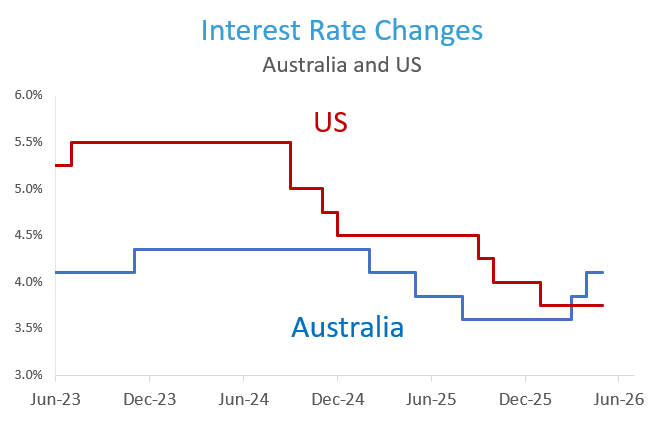
Market Returns to 31 March 2026 (net returns, AUD)
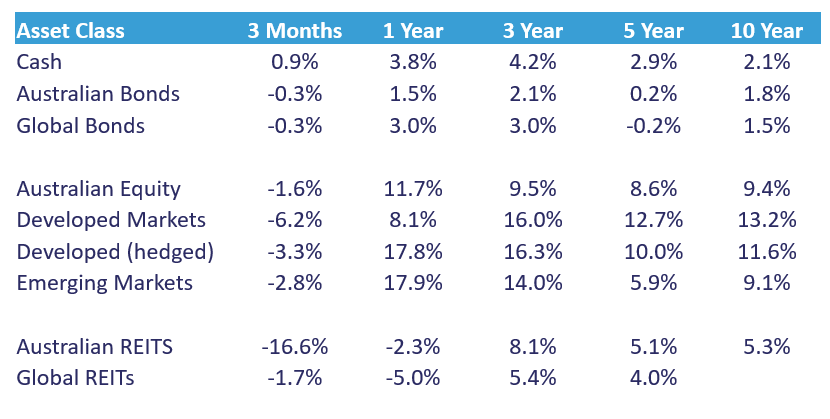
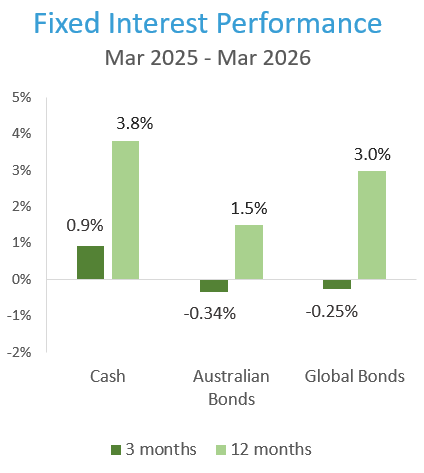
- The spike in oil prices has led to rising bond yields on expectations of higher inflation. Hence all bond indices with duration have seen a negative quarter.
- As with all equity markets, The Australian stock market experienced a negative quarter, as the conflict in the Middle East has led to a spike in oil prices and expectations of higher interest rates required to curb inflation.
- The US market, the largest component of the Developed Market Index, has also fallen on higher energy prices and a reassessment of Federal Reserve policy. This has particularly impacted the more interest rate sensitive Nasdaq index.
- Emerging Markets are similarly negative for the quarter but are showing increased resilience as many countries have shifted towards domestic consumption.
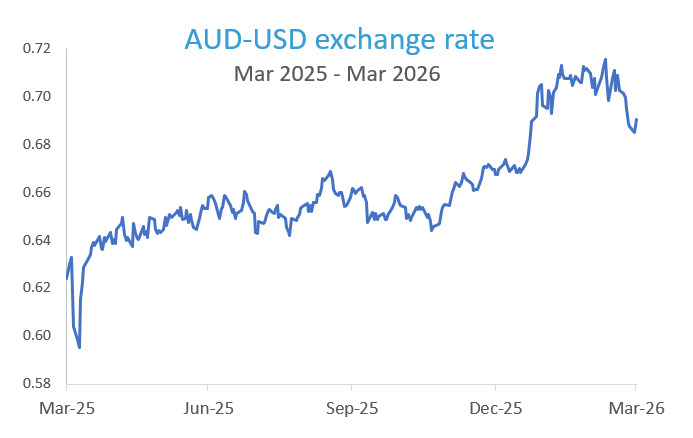
- The Australian dollar relative to the USD has been rising over the year, primarily driven by the interest rate differential between the two countries. The stronger AUD has seen hedged international equities outperform their unhedged counterpart.
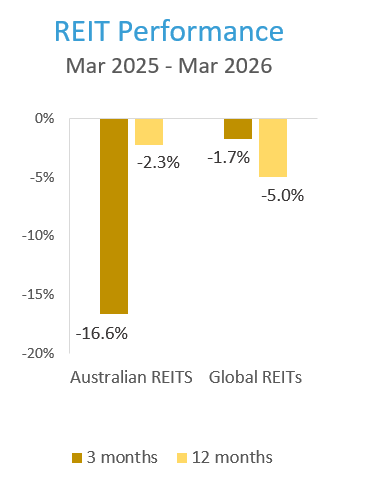
Australian REITs have underperformed their Global REIT counterparts (-16% compared to -3%) primarily due to the concentrated nature of the A-REIT sector.
CRUDE OIL PRICES SPIKE, GOLD PRICE DECLINES FROM HIGHS
Oil prices have experienced a sharp increase as the conflict in the Middle East has resulted in attacks on energy infrastructure, which has severely impacted shipping through the crucial Strait of Hormuz. While gold is usually boosted by conflict, the stronger US Dollar, higher bond yields and surging inflation are all factors in gold’s recent drop.
Market Returns (Chart)
Yield Curves
AUSTRALIA
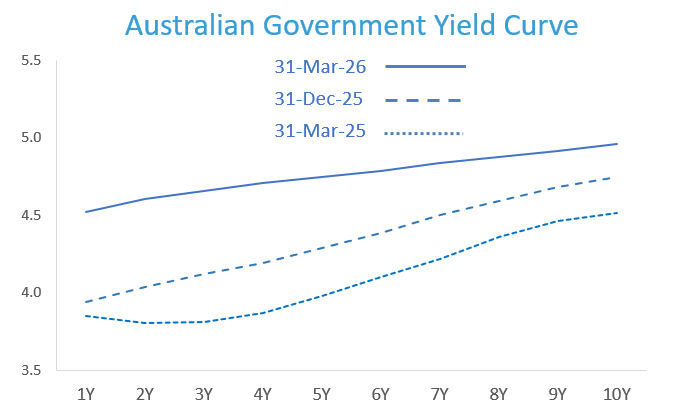
Changes in the yield curve, which dictate the performance of bonds, has been dominated by the conflict in Iran, which has pushed energy prices higher leading to risks of tighter monetary policy and higher bond yields, overpowering the typical flight to safety that usually occurs during geo-conflict. The Australian 10-year government bond yield is near 5%, the highest level in almost 15 years.
UNITED STATES
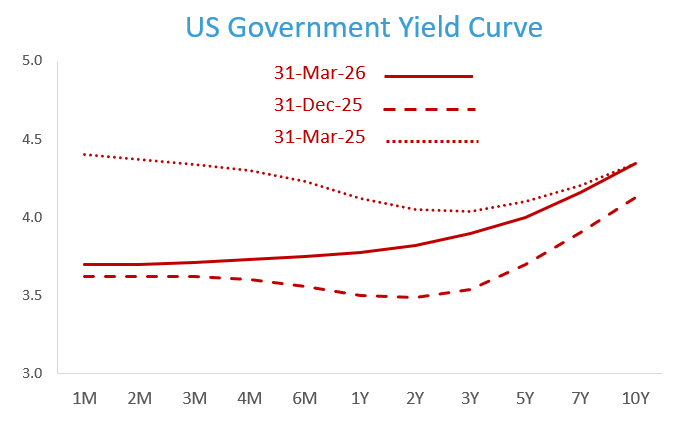
The US yield curve has un-inverted (or "disinverted") after experiencing its longest inversion in history with the curve now “normal”. Despite the shift, the curve remains relatively flat compared to historical norms. This is an indication that the Federal Reserve is likely to leave rates on hold in the near term, reflecting a cautious approach in an environment of rising inflation and slowing growth.
Sector Performance
AUSTRALIA
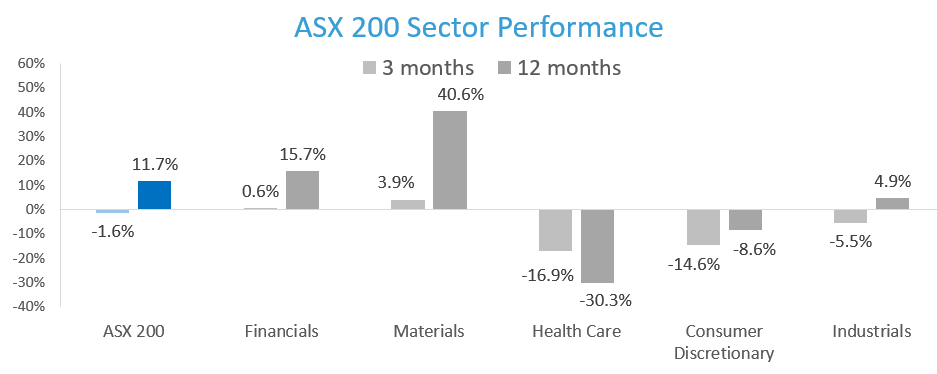
Australia is a concentrated market where a few large stocks dominate sector performance. Beside the general market downturn, the largest IT stocks have been hit by AI disruption while Health Care is down as CSL as fallen by 20% this quarter due to downgraded profit guidance. Consumer stocks are under pressure as spending on luxuries and travel slows. The spike in crude oil prices is reflected in the Energy Sector returning over 30%.
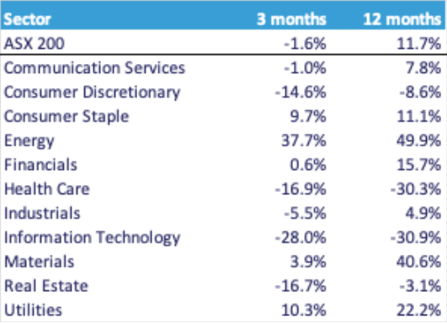
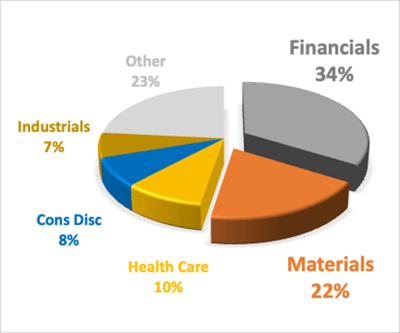
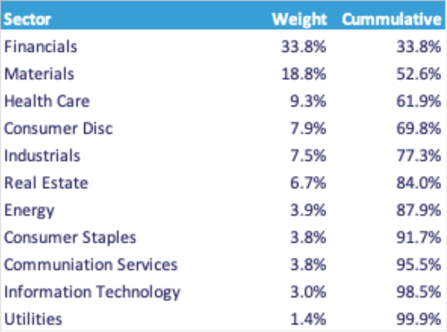
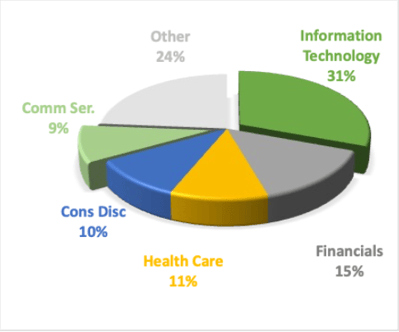
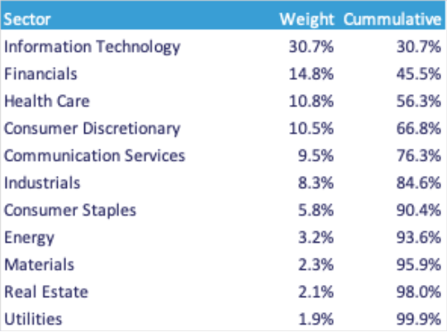
Five sectors make up approximately 75% of the market, with the two largest constituting more than 50%. The bottom chart shows the 12-month performance of the five largest sectors.
Sector Performance
UNITED STATES
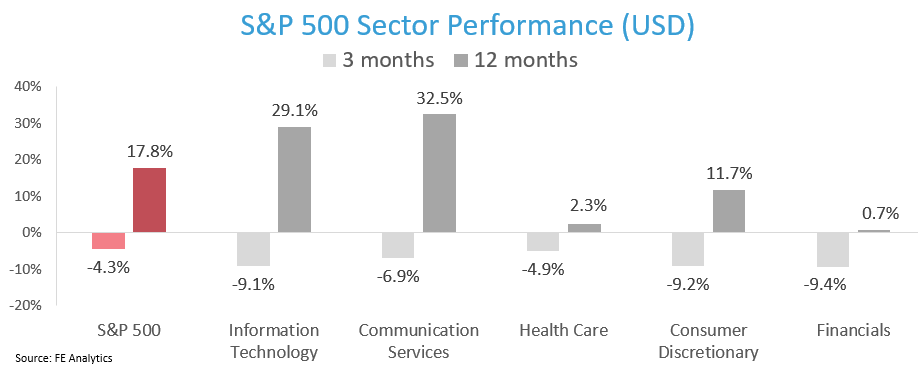
The US Tech sector (Communication and IT stocks) are once again the main drivers of the US market over the last 12 months but are also some of the hardest hit by recent volatility as investors move away from riskier assets. Consumer stocks are under pressure as spending on luxuries and travel slows, while economic uncertainty has weighed on Financials. The spike in crude oil prices is reflected in the Energy Sector returning over 30%.
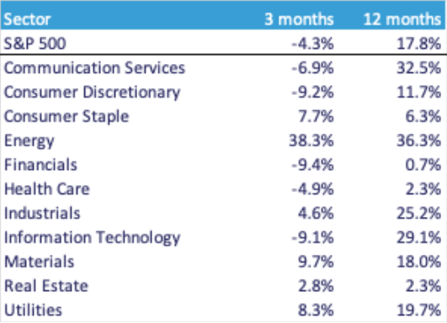
Five sectors make up approximately 75% of the US market, with Tech companies constituting around 40%. The bottom chart shows the 12-month performance of the five largest sectors.
Currency and Crypto
EXCHANGE RATE: AUD UP ON INTEREST RATE DIFFERENTIAL
The AUD finished just under $0.70 at the end of the quarter, having appreciated by more than 10% over the last 12 months as the interest rate differential between Australia and the US continued to widen. More recently the AUD has come off its highs as the conflict in the Middle East has resulted in a stronger USD and a risk-off sentiment in the AUD.
“CRYPTO WINTER”: BITCOIN ON A DOWNWARD SPIRAL
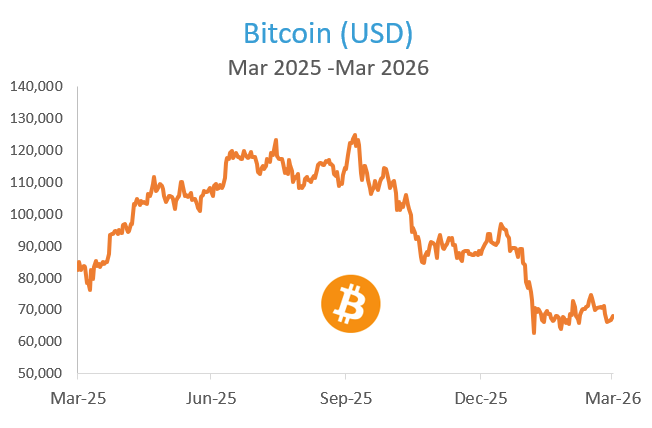
Bitcoin is down by 22% this quarter, and down by more than 45% since its peak in early October. A sell-off of global stocks and bonds and recent volatility in the price of gold and silver are part of the reason for the fall in the price of Bitcoin, as well as regulatory uncertainty. The term “crypto winter” refers to an extended period of declining or stagnant prices.
This article was written by Dr Steve Garth - Principal of Principia Investment Consultants.
Disclaimer: Although information is derived from sources considered and believed to be reliable and accurate, Principia and its employees are not liable for any opinion expressed or for any error or omission that may have occurred in this presentation. This presentation is of a general nature only and has been prepared without considering any person’s particular investment objectives, financial situation, or particular needs.
Leave a Comment