

Recent tensions in the Middle East have unsettled global markets.
Oil prices have risen sharply amid concerns over supply constraints, driving increased volatility across both equities and bonds. In periods like this, it’s natural for investors to feel uneasy.
However, while the headlines may seem confronting, history reminds us that maintaining perspective is essential.

The escalation of the conflict in the Middle East has understandably kept the media in overdrive. When it comes to the financial media, the emphasis has been mainly on energy prices.
Concerns about possible supply disruptions have pushed oil prices higher, which can influence expectations for growth, inflation, interest rates and even investor sentiment.
Importantly, markets appear to be reprising near-term risk rather than signaling a lasting change to long-term economic fundamentals.
Markets have responded, but not in a way that suggests fears of a sustained shock to growth. For example, while a typical measure of volatility has increased since the start of the year, it is nothing out of the ordinary and nowhere near the volatility of early April in 2025 when tariffs were announced and then paused.
The Middle East plays a critical role in global energy supply and concerns about future escalations are absolutely reasonable.
Of course, Periods when both stocks and bonds decline together can feel especially uncomfortable. However, even when uncertainty remains elevated, the reaction of markets to geopolitical events is often sharper than it is lasting.
Geopolitical events have rarely changed long-term market direction unless they lead to prolonged energy disruptions, significantly tighter financial conditions or a broad economic downturn. And those outcomes don't occur, markets have generally recovered, even if tensions persisted for longer.
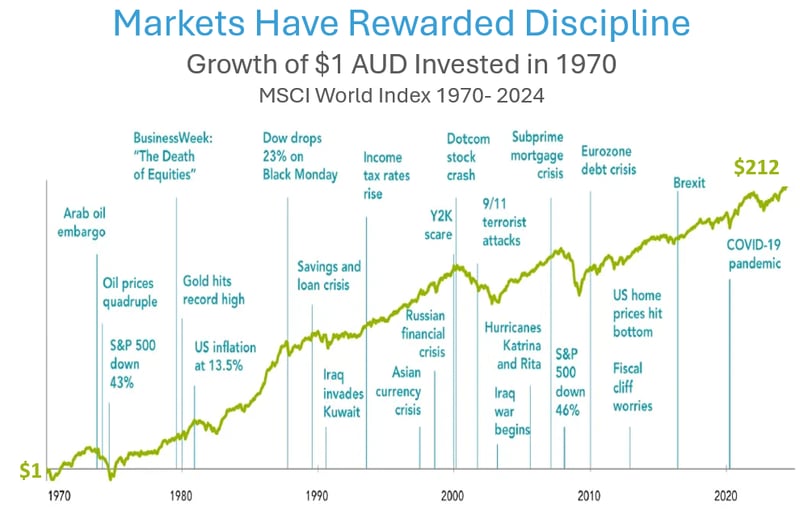
This is borne out in historical stock returns, as shown in the chart below.
Global equity markets have continued an upward climb even in the face of economic and political upheavals. During the past few years, stock markets have had positive returns despite multiple wars being fought around the world.
This is not to trivialise the destruction wars bring and their impact on geopolitical risks, but history suggests investors may not help themselves by divesting from stocks.
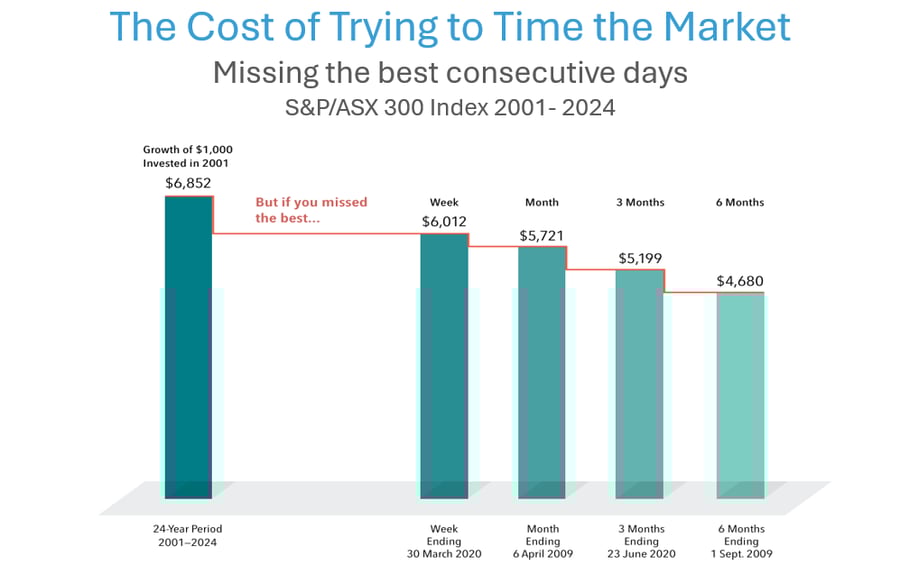
The impact of being out of the market for a short time can be profound, as shown in the below chart.
An investment of $1000 into the S&P/ASX 300 Index made at the beginning of 2001 turns into $6,852 for the 24-year period ending 31 December 2024. Miss the S&P/ASX 300’s best week, and the value shrinks to $6,012. Miss the best three months, and the total return falls to $5,199.
Missing out on those few days with great performance, which may happen to investors that tactically divest after drawdowns, can be detrimental for long-term performance. And missing out for longer periods waiting for the market to “calm down” magnifies this adverse impact. Hence, staying the course and sticking to a long-term investment plan are very important drivers of investment success.
It is important to realize that there is no proven way to time the market by targeting the best days or moving to the sidelines to avoid the worst.
As famed investor Warren Buffet has been quoted as saying
“Don’t try to time the market”.
Buffett’s philosophy emphasizes that "time in the market" beats "timing the market".
Staying invested and focused on the long term helps to ensure that you’re in position to capture what the long-termg term positive returns the market has to offer.
For investors, a few principles are important to keep in mind.
First, diversification matters greatly. It may not prevent short-term losses, but it supports resilience over time.
Second, market timing is hard, if not impossible.
Thirdly, discipline is critical. Volatile markets can tend investors to react emotionally and often at the wrong moment.
Market volatility can be worrisome, no doubt. The feelings generated are completely understandable. But through discipline, diversification, keeping focused on progress to your goals and accepting how markets work, the ride can be more bearable.
At some point, value re-emerges, risk appetites re-awaken and for those who acknowledged their emotions without acting on them, relief replaces anxiety.
Investors who remain disciplined, diversified and who focus on their long-term objectives have historically been best positioned to navigate uncertainty and to participate in future growth.
This article was written by Dr Steve Garth - Principal of Principia Investment Consultants.
Leave a Comment